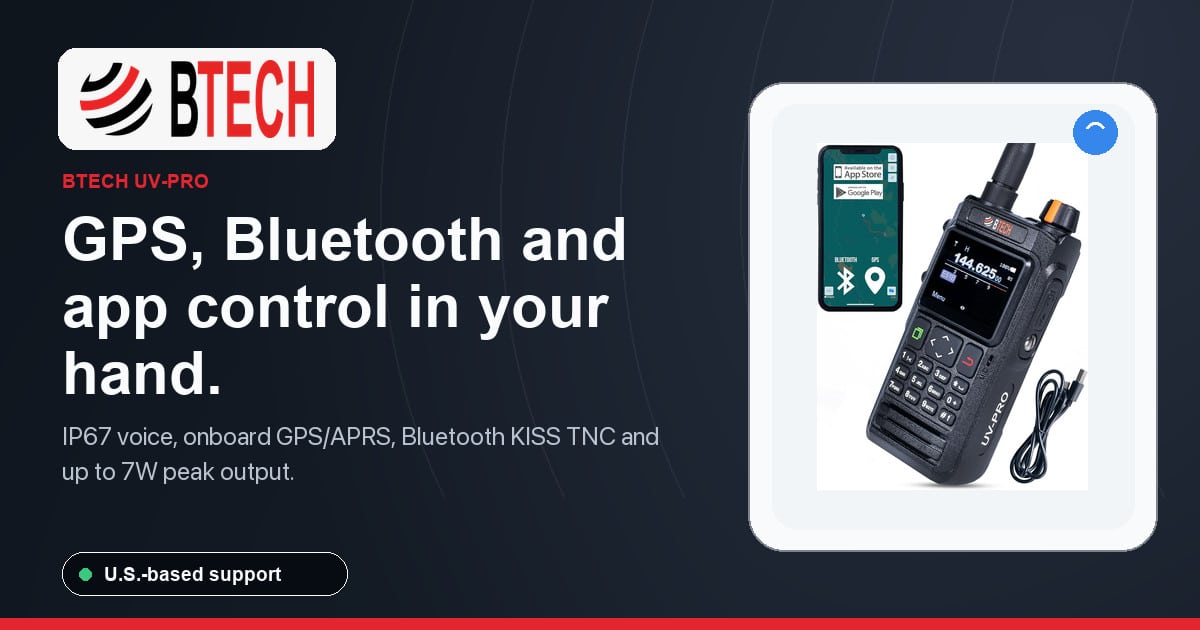
I’ve been interested in something comparable to the BTECH GMRS-PRO, but for HAM bands ever since its. Mid-August they released the UV-PRO, which sort-of fits this description. Mine arrived today. I was mainly interested in (1) the APRS digital mode, and (2) Bluetooth connectivity (both to the phone and to headsets). The first thing I noticed about the UV-PRO is that it is heavy — much, much heavier than the other handsets I’ve used before. I’m not sure if this is the waterproofing, or because the frame is mostly metal, but this might be factor for some uses like backpacking or hiking. At 300 g it sags on my belt, etc. It feels about twice as heavy as a BF-F8HP (which I was using before).In terms of initial impressions: the unit seems solid, and the audio quality is great. I’m getting clear signal reports, audio is crisp both on the speakers and via a Bluetooth headset.As noted, I was mainly interested in the APRS capability, and this is where things get interesting: First, it is technically possible to do most work from the front panel, but this is poorly documented. It wasn’t until I upgraded the firmware, and read the release notes, that I learned I could address messages to callsigns via the “: ” convention. For example, to hit the APRS SMS gateway, I can begin my messages “SMS: ” and things will generally work. To message my other handled unit, I’d use “KK7CMT-5: “, etc. Of course, the same convention works from the connected phone app, and typing is much easier there. Generally, things would be much clearer, if there was an explicit “To” field to fill in.APRS position beaconing also works very well, and I didn’t have much trouble setting that set up. However, I do wish it supported some option to limit precision, and for smart updates (e.g., don’t beacon as quickly when I’m not moving). Maybe this can come in a future firmware.On the other hand, receiving APRS messages was more of a pain. First, I needed to include my callsign and SSID in both the APRS Settings (which makes sense) AND the Signaling Settings (which, I thought was limited to their proprietary BSS protocol). When I just used one, I couldn’t get it to work. Once I figured that out, I also learned that the internal AX.25 decoder is not a sensitive as what I’m used to (Direwolf), and requires both a clear clean signal and a transmission that stays open just a little longer than you might expect. Once a message is received it can be read from the front panel, and replies are easy and straightforward — but all messages are deleted from the unit when it is powered down. This makes it a pain to reply to prior contacts from one session to the next. An address book, or a list of programmable message prefixes would be a huge upgrade (recall, addressing is handled by starting messages with the “callsign: ” prefix.A few other random radio quirks:While you can pair a Bluetooth headset and control volume via headset buttons, the volume settings can quickly get out of sync. For example, it will show as having the loudest volume despite being very low. The only way I’ve found to get them back in sync is use the volume dial on the handset.The channel scanning feature is also not easy to find. Rather than hitting a scan button you need to open Settings->Radio Settings->Scan->Checked. I ended up mapping this to one of the programmable side buttons (requiring the phone application to configure).Finally, while it is nice to be able to program the unit from the phone, I wish I could load in a spreadsheet or similar (like CHIRP) to batch upload a channel list. Programming each channel one by one, on the phone, is still a huge pain. Likewise, channels are divided into 6 groups of 30. I thought I would like this, but it turns out I would much prefer a long linear channel list. It’s a pain to change channel groups from the front panel of the handset (Settings->Radio Settings->Channel Group->Group 1). I mapped these to the programmable buttons as well.

 English